xkcd 285, Wikipedian Protester
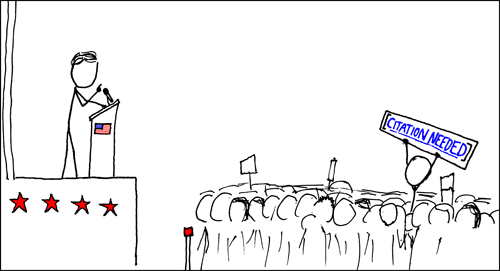
xkcd 285, Randall Munroe, CC BY-NC 2.5.
An agent's memory file is a page of uncited claims with one reader. Anthropic's post on [the components of agent memory](https://www.anthropic.com/research/components-of-agent-memory), published on November 6, admits what that reader does with a wrong one: a later session reads it and trusts it. So when Mads Thines argued on November 7 that [agent memory needs its OpenTelemetry moment](https://www.lorekit.io/blog/open-agent-memory-format), I read it looking for the citation field. He has it, and he leaves it optional, which is the one thing in his proposal for [AI agent memory](https://ninadpathak.com/articles/agent-memory/) I'd change. ## What I make of the proposal I like the problem Thines starts from, and I think his five questions are the right ones for moving a memory between tools. His coding tools each keep what they remember where the others can't read it, and he wants what observability got in 2019: an agreed data model, here covering everything from where a memory is true to which version is current. He's fair to his critics, printing the objection that a trace is written once and a memory gets corrected, and he gets close to my point more than once. He wants a record to say who wrote it and he praises GitHub's Copilot Memory for pairing citations with forgetting, but he leaves the idea as an open question: "Should a record point at the code it depends on?" ## The question I'd add My answer is yes, and I'd make it required. None of his five questions asks how the writer knew, so a record can say where it applies and when it expires and still be wrong. Is there evidence that such a field does the work? Only a hint, and it comes from the Anthropic post. On a benchmark where models built their own notes across sessions, the first model to close the loop wrote entries that carried a rule along with how it knew the rule was true. That describes what a stronger model wrote, and the post doesn't test the clause in isolation, so I won't claim it does. Then there's the note Anthropic quotes from a model playing Pokémon, a rule for what to do after several failed throws: "VARY the timing (insert extra 'wait' presses between menu steps) - the catch landed right after doing this." To me the last clause of that note is a citation. A later session reading it knows the rule came from one success, and can weigh it as that. The post's failure case runs the other way. A model recorded a landmark on the wrong side of a mountain and kept acting on it, and in a separate run a pass that checked the note against the session log caught the error. ## Why I'd settle trust before format I don't think a shared format is the urgent part, and the commenters on [the Hacker News thread](https://news.ycombinator.com/item?id=50411467) made that case well. A commenter argued that a spec matters less here because the reader is an agent, which can already read files in any shape. Another had given up on memory as a feature: "it remembers the wrong things, and then turns them into an inane focus for each task." I read that as a complaint about trust, and a shared envelope would deliver the same wrong things to more tools. Thines half agrees, since his draft record has room for a pull request number among its optional attributes. And a shipped product already goes further: Copilot Memory, in his own table, stores facts with code citations and deletes them after 28 days unused. So optional is the part I'd change. A record with no source should be readable as a guess, the way an untagged sentence on Wikipedia is readable as unchallenged, and a model should be told the difference. ## What a sourced note looks like It needs little. A note says what was observed, where, and when: the command and its output, the file and line, or the turn of the session in which the user said it. I hold a documentation page to that standard, and the reason is the same. A reader who can check a claim doesn't have to trust the writer, and for an agent the writer is an earlier session that can't be asked. My page on [memory serialization](https://ninadpathak.com/articles/memory-serialization/) keeps the log beside the record for this reason, and [memory versioning](https://ninadpathak.com/articles/memory-versioning/) covers what to keep when a note is corrected. A shared format would be worth having once the notes inside it can be checked. --- Hire me: email hello@ninadpathak.com, or book a 30-minute call at https://zcal.co/i/AGG1iJtv Services: https://ninadpathak.com/services/